

INTRODUCTION:
Total
Productivity Management (TPM) originated from Japan way back in the year 1969
when Nippondenso Company Limited belonging to the Toyota Automobile Group
implemented it in 1971. The Japan Institute of Plant Maintenance (JIPM)
instituted the prestigious prize for implementation of TPM. This concept of TPM
stated in Japan when Nippondenso imported the Productive Maintenance from USA
in 1960 and implemented it along with Quality Circle& Total Quality Control
paving way for TPM.
PRESENT
SCENE:
TPM
made its debut in American Industry in 1987. Eastman Company took the lead in
implementation and reported a $5 million annual saving in two years since 1987.
Of late, the Industrial unit in developing countries such as Philippines,
China, Indonesia has also started implementing TPM. In India too, some leading
Industrial house like Birlas, Tatas, TVS Group, IOC have implemented and the
benefits have been documented.
The
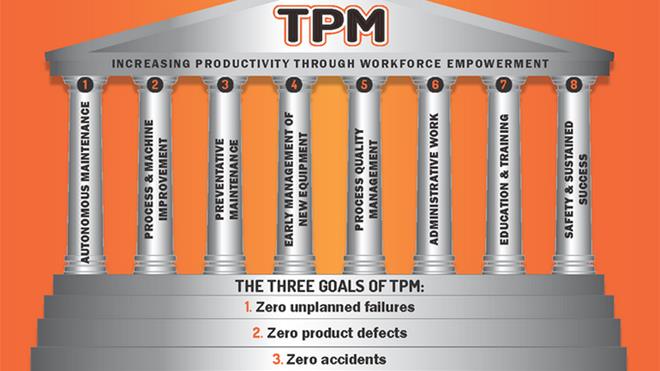
overall objectives of TPM are to improve the whole production process
encompassing a board range of activities which are designated to
Ø
Improve and maximize equipment effectiveness
in quality and performance rediness. It aims to zero losses i.e. zero failure
and zero defects.
Ø Involve
all departments and functions of the company such as planning, operation,
maintenance, design, quality control and stores.
Ø It adopts
a participative management approach, which operates with total participation of
personnel from top management to first line operators.
Ø It
encourages entrepreneurship through small group autonomous maintenance
activities.
Ø It
establishes a total system of preventive maintenance covering the whole life of
the equipment and aims at maximizing overall system effectiveness.
CHARECTERISTIC
OF TPM:
a)
Operator: User maintainer concept
b)
Flexibility: Application of techniques
developed that is considered useful in achieving that stated goals.
c)
Small Group Activity: Small group of maintain
and carryout corrective repairs.
d)
Equipment effectiveness: Control of downtime,
idle time and routine maintenance loses, network/defective production loses,
and loses due to speed of operation.
METHODOLOGY:
TPM is based culture setting through good and effective training and adopting
the best practice from TOP to BOTTOM. It is preferred to involve an external consultant
who can look at each of the functions without any prejudice and act as a facilitator.
The gestation period for the tangible results to accrue is about an year and it
is recommended to consolidate after two years of implementation.
CONCLUSION:
TPM
is the latest stage of management after break down maintenance, preventive
maintenance and predictive maintenance in the order. Remarkable progress has
been achieved mainly by Japanese with this technique and it is recommended for
forward looking Indian Industry aimed at taking on global competition.